
 EN
EN
Concrete Spreader Fundamentals: Equipment Overview and Control Mastery
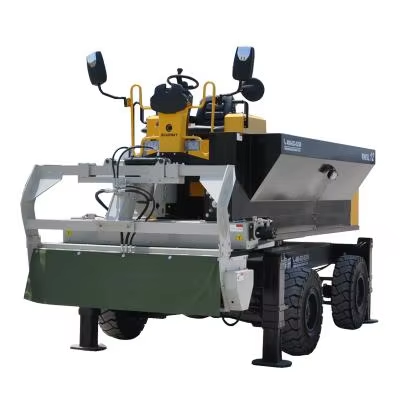
Key components and operational principles of modern concrete spreaders
Today's concrete spreaders typically come equipped with four main components: hydraulic drive motors, adjustable boom assemblies, auger-based distribution heads, and those fancy real-time thickness sensors we've all heard so much about lately. The hydraulic motors keep the auger spinning at just the right speed, which is super important because nobody wants their concrete to separate or segregate during pouring. Most booms can stretch anywhere between twelve to thirty feet out, giving workers plenty of room to place concrete safely without stepping onto freshly poured slabs. When it comes to distribution heads, they usually have these replaceable wear plates that need regular swapping depending on what kind of aggregate size the job requires. Some of the newer high-end models now incorporate laser guided leveling technology too. These systems automatically adjust the spreader height based on preset grade profiles, helping achieve pretty consistent slab thickness across large areas while cutting down on wasted materials in the process.
Hands-on control training: hydraulic systems, boom articulation, and spreader head calibration
Good operator training really hinges on getting three main things right together: managing hydraulic pressure, coordinating how the boom moves around, and calibrating that spreader head just so. New trainees start off learning how to sequence those hydraulic valves properly. They need to match the auger speed with how fast the machine moves forward. If it goes too quick, we end up with underfilled sections. Way too slow? That leaves ugly ridges behind. After getting comfortable there, operators spend time practicing those side-to-side boom movements while keeping the angle between 15 and 30 degrees above horizontal. This helps keep concrete from sliding down instead of spreading out evenly. The last piece involves adjusting those tiny shims inside the distribution head. Believe it or not, changing just half a millimeter in shim position can affect the final thickness by about three whole millimeters. Getting this right means matching what the mix design calls for and meeting finish specs. Most companies won't let anyone work on actual jobs until they consistently hit within plus or minus five millimeters across multiple test pours. And when it comes time to prove competence, most shops stick with those official OEM checklists to make sure everyone meets the same standards.
Concrete Spreader Safety: OSHA Compliance and Risk Mitigation
Identifying and mitigating site-specific hazards—overhead obstructions, unstable ground, and utility proximity
Before starting any operation, checking for potential hazards is absolutely essential. Workers need to look out for things like overhead power lines running across the site, patches of ground that feel unstable underfoot, and those hidden utility lines beneath the surface. Ground instability alone can make machines tip over much more easily than expected, with studies showing around a 37% increase in such incidents according to recent construction safety research. To stay safe on the job site, experienced crews use several proven methods. They often employ laser rangefinders to spot obstacles from a distance, lay down geotextile fabric to stabilize soft spots in the earth before moving heavy equipment into position, and run ground penetrating radar scans to map out exactly where underground pipes and cables might be hiding.
Essential OSHA-aligned protocols: lockout/tagout, PPE requirements, and emergency stop response
Following OSHA rules means sticking closely to lockout/tagout (LOTO) protocols when doing maintenance work so machines don't accidentally start back up while someone is working on them. Workers need proper gear too including those hard hats that meet ANSI standards, bright orange vests that stand out even in dusty conditions, and sturdy steel toe boots built for rough construction sites. The safety manual also specifies that everyone has to hit that red emergency stop button within three seconds once they spot something dangerous happening. Companies run regular practice sessions for this because real world tests show these drills cut down reaction times by almost two thirds according to recent research from the Construction Safety Journal last year.
Concrete Spreader Operator Proficiency: Supervised Training and Competency Validation
Structured progression: shadowing – guided operation – supervised solo execution
Proficiency develops through a scaffolded, evidence-based progression:
- Shadowing phase: New operators observe experienced crews managing real-world variables—boom height adjustments, head calibration for varying slump, and edge feathering techniques
- Guided operation: Under direct supervision, trainees practice hydraulic control and boom articulation while receiving real-time feedback on distribution uniformity
- Supervised solo execution: Operators execute full-scale pours independently, with trainers monitoring safety compliance, material consistency, and procedural accuracy
This tiered method reduces operational errors by 47% (Construction Training Institute, 2023) and accelerates muscle memory development for complex, simultaneous controls.
Competency assessment framework aligned with OEM standards and recertification best practices
Validation requires 90% precision in slab thickness consistency across multiple test pours. Leading programs include biannual refreshers covering innovations such as laser-guided leveling—particularly critical given data showing unrecertified operators exhibit 34% higher fault rates in edge feathering and surface finish quality.
FAQs
What are the key components of a modern concrete spreader?
Modern concrete spreaders typically have four main components: hydraulic drive motors, adjustable boom assemblies, auger-based distribution heads, and real-time thickness sensors.
Why is managing hydraulic systems important in concrete spreader operation?
Proper management of hydraulic systems is crucial to ensuring the correct operation speed of the auger and spreader, preventing underfilled sections and ridges. This helps maintain even concrete distribution.
What are some specific safety protocols for using concrete spreaders?
Safety protocols include lockout/tagout procedures during maintenance, wearing PPE like ANSI standard hard hats and steel toe boots, and learning to quickly hit emergency stop buttons during an incident.