
 EN
EN
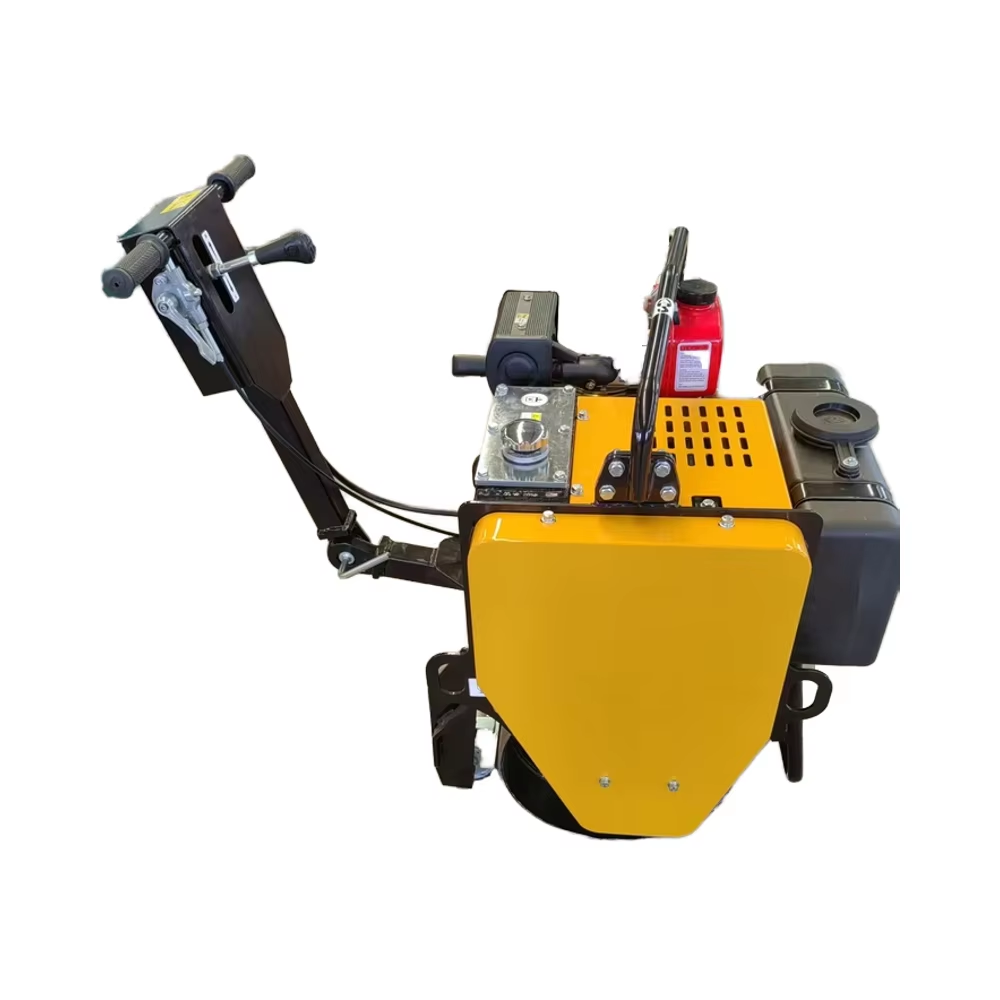
How the Vibratory Roller Achieves Optimal Asphalt Compaction
Vibration frequency and amplitude: engineering particle rearrangement in hot-mix asphalt
Walk behind vibratory rollers work really well for getting asphalt as dense as possible because they have these special vibration systems built right in. Inside the roller drum there's something called an eccentric rotating mass that creates those repetitive forces we see happening between 40 to 50 times per second. These fast vibrations basically make the particles in hot mix asphalt lose their grip on each other for a moment. What happens next is pretty cool - the loose particles can actually move around and pack together tighter, pushing out all that trapped air without breaking anything apart. When it comes to adjusting how much force gets applied, operators look at amplitude settings usually somewhere between 0.3 and 0.8 millimeters. Lower numbers help keep the top layer intact when working with thinner sections of road, whereas bigger numbers let the compactor reach down deeper into thicker layers. According to actual field tests, these vibrating machines typically hit around 92 to 96 percent of what's considered maximum possible density. That beats out traditional static methods hands down since regular rollers just can't get rid of those stubborn air pockets the same way.
Why vertical vibration outperforms static weight alone – dynamic force transmission explained
When it comes to compacting asphalt, vertical vibration works better because it sends dynamic energy straight down through the layers something regular static rollers just can't do. The drum moves back and forth creating these repeating forces that actually cause particles to separate briefly before settling properly under their own weight. What happens next is pretty impressive too. These vibrations create compaction pressure around three times what the machine weighs when sitting still, and they reach down about 24 inches deep compared to only 12 inches for those old school static rollers. Contractors find this makes a big difference since they hit their target density much faster, cutting down on the number of passes needed by anywhere from 30 to 50 percent. Projects get finished quicker and there's less sideways movement messing up the mix. Plus, the controlled nature of the vibration helps avoid problems like cracking small stones in thin layers, which ensures roads stay strong and even distributed loads over time instead of breaking apart prematurely.
Critical Applications Where the Walk-Behind Vibratory Roller Is Indispensable
Edge compaction, patchwork, and confined-area paving inaccessible to ride-on rollers
Walk-behind vibratory rollers are indispensable where traditional ride-on equipment cannot operate. Their compact size, low turning radius, and operator-controlled maneuverability make them uniquely suited for:
- Edge compaction along curbs, barriers, and medians—zones historically prone to density deficiencies
- Patchwork repairs, including pothole fills and utility cuts, where localized, high-force application is required
- Trench backfilling around pipes and cables, preventing post-construction settlement—a failure mode cited in 78% of infrastructure-related compaction audits (2023 National Pavement Preservation Survey)
- Confined spaces, such as narrow alleyways or densely landscaped areas with clearance under 36 inches
The targeted vibration frequency range (3,000–5,000 VPM) ensures consistent, uniform compaction in these high-risk zones. Project managers report a 92% reduction in edge cracking when walk-behind vibratory rollers replace manual tamping or oversized equipment—delivering measurable lifecycle cost savings.
High-precision use cases: bridge decks, utility trenches, and sidewalk transitions
For structural elements demanding surgical precision, walk-behind rollers provide unmatched control and responsiveness:
- Bridge deck joints, where over-compaction can compromise expansion joint integrity
- Utility trenches, requiring balanced support around sensitive conduits without disturbing adjacent infrastructure
- Sidewalk transitions, where exact grade matching prevents trip hazards and water ponding
- Landscaped hardscapes, including retaining walls and decorative pavers, where surface finish and stability are equally critical
The major industry specs like ASTM D6931 and AASHTO T 193 require at least 95% density for proper compaction in construction projects. Walk behind vibratory rollers tend to hit this mark reliably because operators can adjust the amplitude settings precisely. This helps keep the aggregate materials intact especially important for thin layers less than two inches thick. Field reports from bridge maintenance crews show something interesting too. When workers use walk behind rollers instead of larger ride on models for compacting transition areas between different sections, there's about a 40% drop in problems related to joints failing later on. Makes sense really since those smaller machines can get into tight spots better and apply just the right amount of pressure without overdoing it.
Performance Trade-Offs: Efficiency, Density, and Risk Management with the Vibratory Roller
Field-proven gains: 12–18% faster pass efficiency and 92–96% density attainment under optimal conditions
The benefits of modern vibratory rollers become clear when looking at how they work with the physics of compaction. Field tests have shown workers can finish passes about 12 to maybe even 18 percent quicker than with older static models. This means fewer man hours spent on jobs and getting more ground covered each day. For best results, most operators find that setting their machines between around 2,000 to 4,000 vibrations per minute works well, especially when combined with amplitudes somewhere between 0.4 and 0.8 millimeters. Under these conditions, the equipment typically hits about 92 to 96 percent of what's theoretically possible for density in both granular bases and hot mix asphalt layers. But it's important to note that achieving these numbers depends heavily on matching drum speeds, proper overlaps, and adjusting vibrations based on actual site conditions like material temperature and layer thickness. Getting this right helps meet those ASTM D2950 and AASHTO T 193 standards that everyone in the business knows are critical for quality control.
Mitigating over-vibration risks – balancing density targets against aggregate fracture in thin lifts
Aggressive vibration poses significant fracture risks in thin asphalt lifts (<2 inches), where excessive force can shatter 20–30% of surface aggregates—compromising surface durability and skid resistance. To mitigate this:
- Operators reduce amplitude to ≈0.5 mm and frequency to ≈3,000 VPM for lifts under 2 inches
- Infrared thermographic and ground-penetrating radar (GPR)-enabled density monitoring allows real-time verification, enabling cessation at precise 95% thresholds
- Sequential “pass mapping” software prevents overlapping vibrations on vulnerable edges and transitions
This calibrated approach maintains 91–94% density in high-risk zones—including utility trenches and curb returns—without triggering costly remediation or premature surface raveling.
FAQ
What is the role of vibratory rollers in asphalt compaction?
Vibratory rollers use specialized vibration systems to shake down and compact asphalt layers, allowing particles to settle tightly together and achieve high density levels.
Why is vertical vibration preferred over static weight for compacting asphalt?
Vertical vibration applies dynamic energy more efficiently, reaching deeper layers and achieving target density faster than static methods.
Where are walk-behind vibratory rollers most effectively used?
Ideal for compacting edges, patchwork repairs, trench backfilling, confined spaces, bridge decks, utility trenches, and sidewalk transitions due to their precision and maneuverability.
How do vibratory rollers manage over-vibration risks?
By adjusting amplitude and vibration frequency, using real-time monitoring, and applying pass mapping software, operators prevent aggregate fracture in thin asphalt layers.